
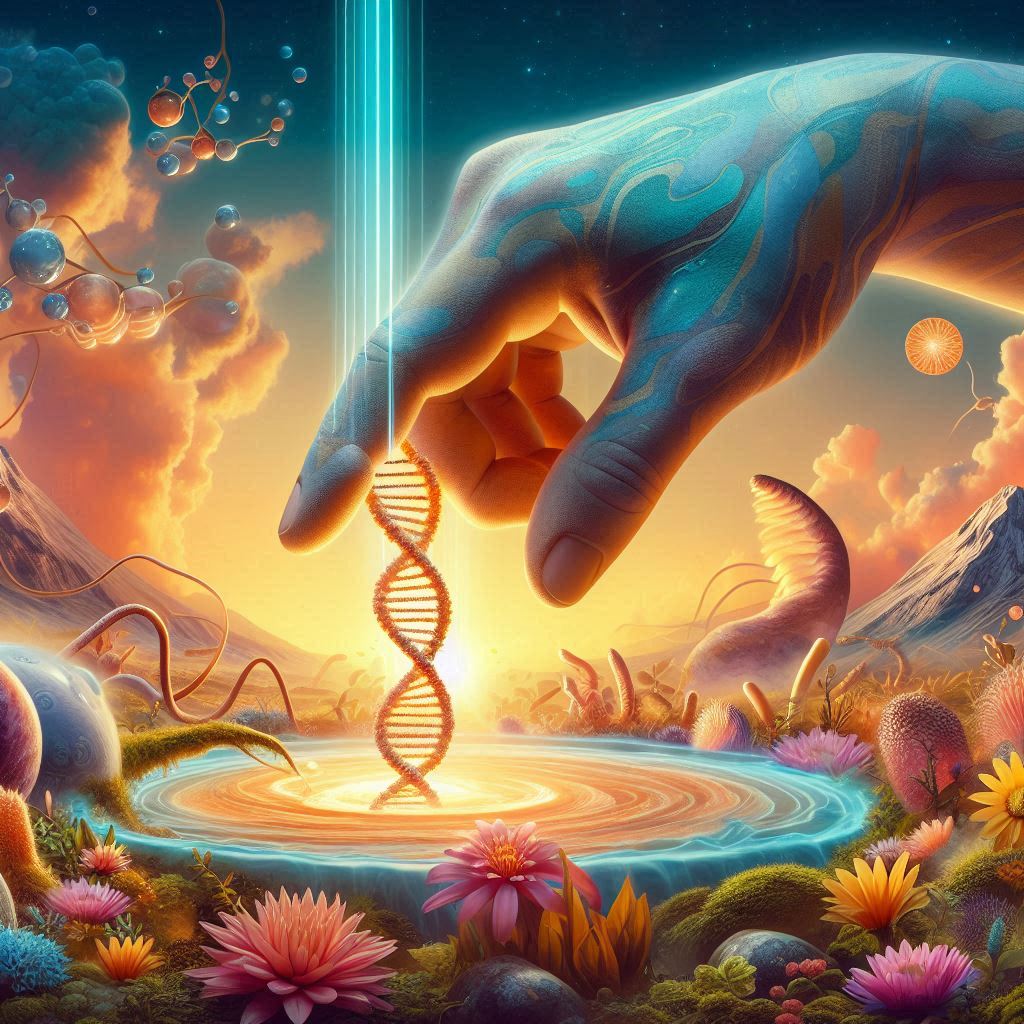
Is it possible to be a Christian and to believe in evolution? Is the Biblical account of Creation correct? Does evolution discount the Creation narrative in Genesis? Is evolution fact, fiction, or flawed? How should we debate an atheist who believes evolution proves the Bible is wrong and God was not needed to create life?
We are going to try to look at some of those questions in this article.
Disclaimer: This article draws heavily from information taken from three main sources, they are Darwin’s Doubt by Stephen C Meyer, I Don’t Have Enough Faith To Be An Atheist by Norman L Geisler and Frank Turek, and The Questions Christians Hope No One Will Ask by Mark Mittelberg. I will try to credit everything, but if proper credit is not given in any case it is purely accidental.
The reason I titled this article Evolution “AND” Creation and not Evolution “OR” creation is because when it comes to creation and evolution Christians have different interpretations and opinions.
There are certain issues in Christianity which are fundamental to the faith, certain issues in which all Christians must believe in order to be a Christian. Certainly when it comes to creation Christians believe there is one God who created the heavens and the earth, but how He did it we do not know. When it comes to the “how” I believe there is no one belief that is essential to the Christian faith. If we knew the “how” we would be God, but since we are not God we, as humans, love to speculate and investigate and it is no different on this issue.
Here are a few of the interpretation philosophies Christians have on Creation and evolution:
First, I want to start off by giving you my personal belief; I believe God created Adam fully formed first and then created Eve out of Adam, I believe that God created all life as we know it today. I do not believe the days in the Bible are literal days because the Hebrew word yôhm, which is interpreted as “day” in Genesis, can also be used figuratively to represent a longer period of time.1
Some Christians believe the days in Genesis are literal days, this is called Young Earth Creationism. Others believe in Old Earth Creationism, and this is the belief that God set the process of evolution in motion and then intervened at certain points during the process and that’s where the “days” (ages) in Genesis come from. Still other Christians believe in Theistic Evolution, this position holds that God worked continually behind the scenes through evolution to create all life.2
Christian philosopher and apologist G.K. Chesterton defended Christianity against Darwinist attacks saying the following:
If evolution simply means that a positive thing called an ape turned very slowly into a positive thing called a man, then it is stingless for the most orthodox; for a personal God might just as well do things slowly as quickly, especially if, like the Christian God, he were outside time.3
Augustine of Hippo was an early church father and he didn’t believe the days in Genesis had to be taken literally, he also believed the world could have been made by God with certain potencies that unfolded in the progress of time. This sounds like he is speaking of evolution hundreds of hears before Darwin posited his theory.
So, when it comes to creation we can see by Chesterton and Augustine that a belief in God using the evolutionary process to create life does not disqualify a person from being a Christian.
The fact that Christians have different beliefs on evolution and creation could actually help us when we debate atheists who believe evolution disproves God. Our biggest concern is to get them to start thinking about God. We can try to meet them on their ground; instead of trying to show them evolution is wrong we should use this opportunity to show them that even evolution points back to God. This is called the “Even If” approach.4 Our first priority is to get them to come to Christ.
First, I am going to talk a little about the problems, or gaps, in Darwinism and then we’ll focus on how to bring the conversation back to God.
There are at least four main issues with Darwinism, there’s probably more, but we’ll focus on these four:
- Darwin didn’t explain how life began, his theory begins with an already living organism and tries to explain the progression of life from an existing simple single cell life form. 5
- We now know that a simple single cell organism contains enough information to fill libraries with books. It’s hardly the simple cell science once thought it to be in Darwin’s time.6
- Fossil evidence from the Cambrian era points to the sudden appearance of all life forms virtually simultaneously and they were fully formed with no signs of evolution.7 Darwin knew this was a problem but he had hoped the answer would be discovered by science in the future. It still hasn’t been…8
- Darwin’s followers have conflated micro (or adaptive) evolution with macro-evolution. Micro-evolution is subtle evolutionary changes within a species to adapt to its environment and there is scientific evidence this has taken place. Macro-evolution is the evolution of one species into another. There is not one trace of fossil evidence that shows this has ever happened. 9 This has been done purposefully in my opinion because when people hear the word “evolution” they naturally think scientists are talking about macro-evolution when they are actually talking about micro-evolution.
All of these questions can be used to bring the conversation back to God by asking the following questions:
- Where did the environment (the creation) come from that set the stage for life? And how was it perfectly situated to accommodate and sustain life. This is not explained by Darwinism.10
- Where did the first life form come from? This also was ignored by Darwin, although subsequent scientists have tried to explain it.11 Their explanation falls flat based on the next question:
- Where did all the libraries worth of information needed to create a single cell come from? 12 Information is knowledge and that type of knowledge cannot be explained away by chance. There has to be a “knower” for lack of a better word.
These three issues point to a creator who had to create the conditions for evolution to take place.13
People can be stubborn, especially when you are challenging long-held beliefs. I believe the best approach is to explain to them that if evolution is true it still needs a designer to set the process in motion by creating the universe where evolution takes place, by creating the perfect environment to sustain life, by creating all of the information needed for life, and by creating the first life form. If you can get them to start thinking about this, the seed will be planted and they may come back for more conversation.
Our first priority is getting them to come to God, what follows could be a change in their beliefs on evolution but even if there isn’t, there are plenty of Christians who believe in God and evolution and we should be happy to accept another one.
“I am the Lord, who made all things, who alone stretched out the heavens, who spread out the earth by myself” Isaiah 44:24
If you enjoyed this content please scroll down and leave a comment, subscribe, and share!
- ESV Key Word Study Bible ↩︎
- This is my summary from “The Questions Christians Hope No One Will Ask” Please see that book for a more detailed account of these positions ↩︎
- G.K. Chesterton in his book “Orthodoxy” ↩︎
- The Questions Christians Hope No One Will Ask ↩︎
- The Questions Christians Hope No One Will Ask ↩︎
- I Don’t Have Enough Faith To Be An Atheist and The Questions Christians Hope No One Will Ask ↩︎
- Darwin’s Doubt ↩︎
- Charles Darwin considered this sudden appearance of a solitary group of trilobites, with no apparent antecedents, and absence of other fossils, to be “undoubtedly of the gravest nature” among the difficulties in his theory of natural selection. He reasoned that earlier seas had swarmed with living creatures, but that their fossils had not been found due to the imperfections of the fossil record. In the sixth edition of his book, he stressed his problem further as: “To the question why we do not find rich fossiliferous deposits belonging to these assumed earliest periods prior to the Cambrian system, I can give no satisfactory answer.” From Darwin’s Doubt ↩︎
- I Don’t Have Enough Faith To Be An Atheist ↩︎
- The Questions Christians Hope No One Will Ask ↩︎
- The Questions Christians Hope No One Will Ask ↩︎
- The Questions Christians Hope No One Will Ask ↩︎
- The Questions Christians Hope No One Will Ask ↩︎

 Cross Talk
Leave a Reply