
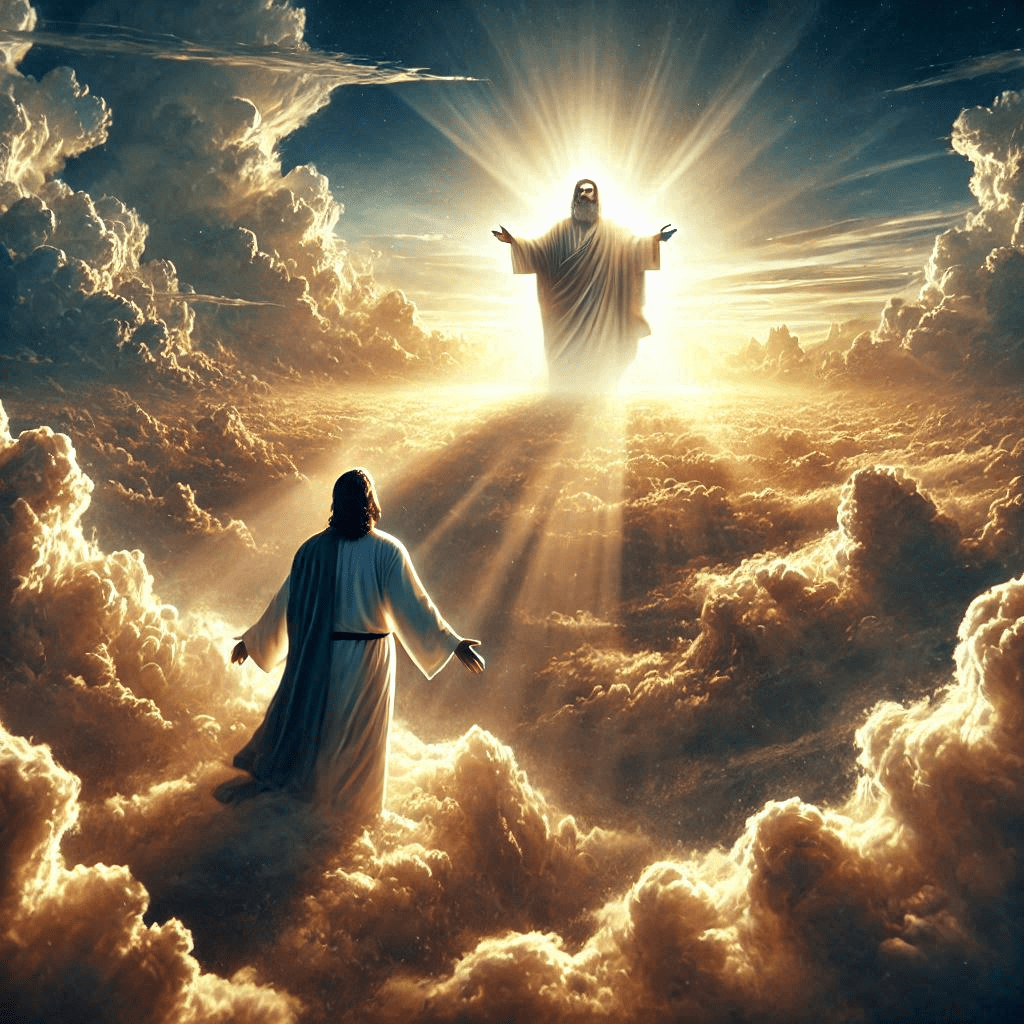
I have already written about one of the Bible passages skeptics cite to claim that Jesus himself admitted he was not God, Luke 18:19, you can read that post here. Today we are going to look at a second passage skeptics also use for the same purpose, John 14:28:
28 You heard me say to you, ‘I am going away, and I will come to you.’ If you loved me, you would have rejoiced, because I am going to the Father, for the Father is greater than I. (ESV)
Skeptics ask, if Jesus is God, and Jesus and the Father are one1 how can the Father be greater than Jesus? Aren’t they equal? Isn’t this an admission by Jesus that he is not God? I think these questions are understandable and questions that should be answered because on the surface it certainly looks as if Jesus is admitting that God is greater than he is. And if God is greater than Jesus than Jesus is admitting that he is not God. Of course, we must go beyond the surface of the verse to get to the truth.
I think there are two factors we must look at. The first factor is, we are dealing with a difference between Jesus’ divine nature and Jesus’ human nature. Jesus was fully divine and fully human. We must separate Jesus’ nature into these two classes, and look at them separately, to begin to understand. First, the human nature, how did Jesus go about his ministry?
Jesus as a Servant
In heaven the Father, the Son, and the Holy Spirit are one God and they are equal. When Jesus came down to earth and took on human nature he came as one who serves.2 He came to earth to serve us by showing us the way, and ultimately dying for us, and he came to serve the Father by submitting to his will and by implementing his plan of redemption for all mankind.
Jesus himself said a servant is not greater than his master, and a messenger not greater than the one who sent him.3 He gave up his heavenly station, the very glory of heaven, and in his humanity became subservient to the Father as his messenger on earth, but at the same time he was still God. Having carried out his mission on earth he is now seated at the right hand of the Father, crowned again in all his glory.
The NLT states it like this in Philippians 2:6-11:
6 Though he was God,
he did not think of equality with God
as something to cling to.
7 Instead, he gave up his divine privileges;
he took the humble position of a slave
and was born as a human being.
When he appeared in human form,
8 he humbled himself in obedience to God
and died a criminal’s death on a cross.
And there is this from Hebrews 2:9:
9 But we see him who for a little while was made lower than the angels, namely Jesus, crowned with glory and honor because of the suffering of death, so that by the grace of God he might taste death for everyone. (ESV)
These passages clearly show us that Jesus was equal to the Father, but that he gave up his position to come to earth as a slave and he humbled himself to the Father in complete obedience. In his roll as a human messenger on earth Jesus was less than the Father, as we all are, but as God he is equal with the Father.
The Trinity
This leads us into the second factor, Jesus’ divine nature. This takes us to the Trinity itself. There is no way that we can fully understand the inner workings of the Trinity, it is simply beyond human understanding, but we can try to form an incomplete understanding of the Trinity.
The three members of the Trinity are equal, they are all of one essence, or nature, of the same power, and have the same attributes, yet they are three distinct persons, or offices, of the Trinity and carry out three different roles as God. The Father, the Son, and the Holy Spirit are not each 1/3 a part of God which combined make up the whole, they are all 100% God. Skeptics are confusing the one essence/nature of God with the different roles of the three members of the Trinity. Jesus’ role as Son was to spread the word of God the Father’s plan to the people and this is what he did as his messenger.
There have been many, many analogies put forth to try to describe the Trinity, but all of them fall short. I hesitate to use any analogies, but here I go anyway:
Augustine of Hippo came up with a few analogies of the Trinity in his work entitled On The Trinity. I think one of his more interesting analogies is memory, understanding and will. The memory (or history/knowledge) being the Father, God’s understanding (Word) being the Son, and God’s Will (Spirit?) being the Holy Spirit. I think this analogy at least captures the idea of the three different roles of the Triune God.
We can think of it this way: The Father has the plan (the Father is all Knowledge) to redeem mankind, He sends the Son to explain the plan (the Word of God’s plan) and the Spirit is charged with administering the plan by emboldening those who accept the Word of God. All three working perfectly together and as one for a common purpose.
We can relate this to a workplace, a company has owners, bosses, and workers. People with three different roles in one larger entity all working together. The owners have a vision for the company which they relate to the bosses, the bosses implement the vision and explain it to the workers, and the workers are tasked with carrying out the plan.
Out of all of the analogies that have been put forth, the best one might actually come from Paul when he was speaking about the body of Christ, the church. He said there are many parts yet only one body, all working together in different but equally important roles, with no division.4
While Paul was not speaking of the Trinity here, I think the Trinity works in much the same way.
Summary
Jesus, as God on earth, came to us as a servant and gave up what was rightfully his in heaven to carry out the Father’s plan of salvation for all mankind. As a human servant he was subordinate to the Father, but this should not be confused with his divine nature.
As an inseparable part of the Trinity he was still equal with the Father and the Holy Spirit. All three members of the Trinity played (and still play) equally important but different roles in God’s plan to redeem mankind.
With Jesus’ earthly incarnation complete he now sits in his rightful place in heaven at the right hand of the Father.
If you enjoyed this content please scroll down and leave a comment, subscribe, and share! You can also follow Cross Talk on Facebook by clicking on the Facebook icon on the Cross Talk homepage.


 Cross Talk
Leave a Reply to No One Knows the Hour, Not Even the Son – Cross Talk Cancel reply