
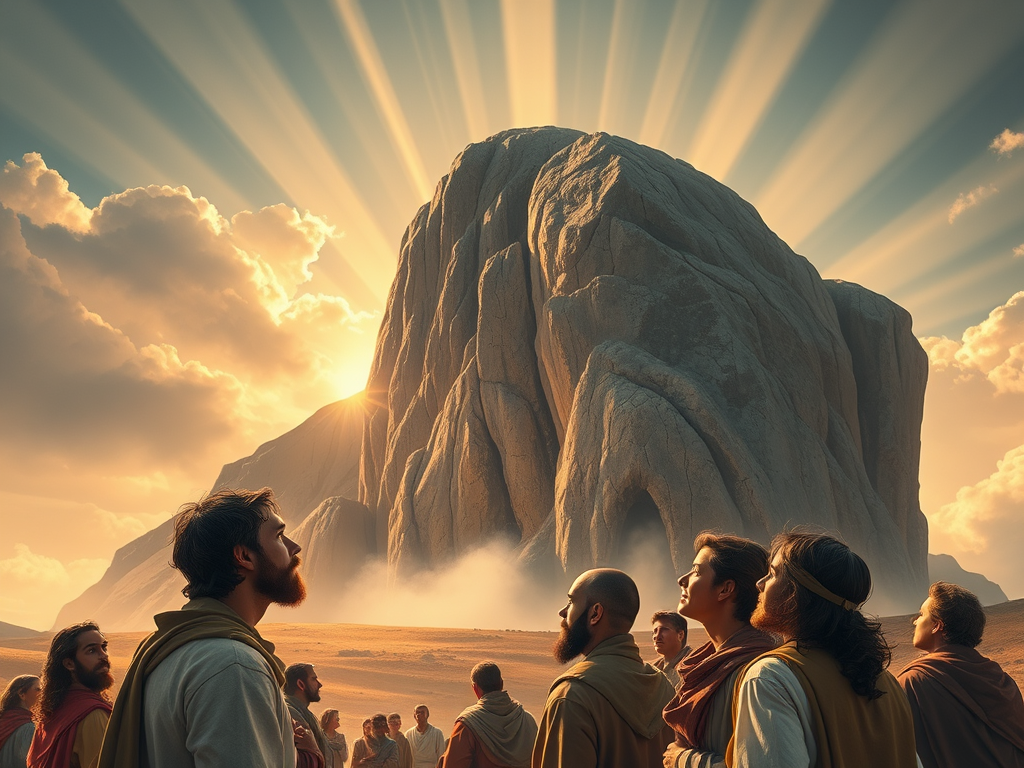
Today we are going to look at Peter’s confession of faith in Matthew 16:16, Jesus’ response to him, and the debate which has ensued. But first let’s set up the story.
When Jesus and his disciples came to Philippi Jesus turned to them and asked “who do people say the Son of Man is?” The disciples responded by repeating what they had heard, some people were calling him John the Baptist, others were calling him Elijah, some were calling him Jeremiah, and still others were saying he was one of the other prophets.1
Who do You Say I Am
This is when it got real: Jesus then asked them, “but who do you say I am?”2 [emphasis mine] Peter was the first to speak up:
16 Simon Peter replied, “You are the Christ, the Son of the living God.” 3
Jesus responded:
“Blessed are you, Simon Bar-Jonah! For flesh and blood has not revealed this to you, but my Father who is in heaven. 18 And I tell you, you are Peter, and on this rock I will build my church, and the gates of hell shall not prevail against it.4
Peter confessed Jesus as the Messiah. But Jesus’ answer has been the subject of interpretation and debate. What is the rock Jesus is talking about? Jesus’ response has a few different interpretations. There are two interpretations which I am going to focus on, because I believe these are the two most prevalent.
Peter as the Rock
The first interpretation is that Peter is the rock. Jesus was clearly making a play on words between πετρος (Peter’s name, which means stone) and πέτρα (rock). Jesus went on to say he would give Peter the keys to the Kingdom of Heaven.5 Given these points it does indicate that Jesus was acknowledging Peter would be a leader in the early church. There is no doubt that Peter was the first leader of the church in Jerusalem after being filled with the Holy Spirit at Pentecost.
This could be a valid interpretation, and this is the interpretation the Roman Catholic Church holds to be true. The Roman Catholic Church takes it beyond this and uses this verse to claim Peter was the first Pope and that the papacy has been passed down through him until this day.
Peter’s Confession of Faith as the Rock
The second interpretation holds that the rock was Peter’s confession of faith. Let’s look at this a little closer. First, Jesus said that Peter was blessed because God in heaven revealed this (confession of faith) to him. From there Jesus addressed Peter by name and then said he would build his church on this rock.
It becomes apparent, according to this interpretation, that there is a connection between this rock he will build his church on and this (confession of faith) Peter spoke of and not Peter himself.
This could also be a valid interpretation, and this is the interpretation that many of the Protestant denominations hold to be true. Protestant denominations deny this verse is the foundation of the Roman Catholic Church with Peter as the first pope.
So which interpretation is true? Is either? Is the answer somewhere in between? We will have to dig a little deeper into scripture to see if we can come up with an answer.
Peter as the Leader of the First Church
Let’s look at some more evidence from the Bible:
In addition to the leadership role Jesus gave to Peter in the verse we have been discussing, Jesus also gave Peter a pastoral role when he reinstated Peter after his denial of Christ:
“Lord, you know everything; you know that I love you.” Jesus said to him, “Feed my sheep.6
So it looks as though Peter was commissioned by Jesus as the first shepherd and founder of the church, but what is the foundation of the church? What was the church built on?
Jesus as the Foundation and the Cornerstone of the Church
A few chapters after Jesus said he would build his church on this rock he called himself the cornerstone by alluding to prophesy:
“‘The stone that the builders rejected
has become the cornerstone;7
When talking about people who had laid the foundations of the church, and discussing unity in the church, Paul made it clear that people such as himself and Apollos were just men and that they were building on the foundation of Jesus Christ:
10 According to the grace of God given to me, like a skilled master builder I laid a foundation, and someone else is building upon it. Let each one take care how he builds upon it. 11 For no one can lay a foundation other than that which is laid, which is Jesus Christ.8
This should not only apply to Paul and Apollos, but to anybody who was planting a church, and this means it should also be applied to Peter. Peter was building the church on the foundation of Jesus Christ.
Again, when Paul was writing about the unity between the Gentiles and Jews in Christ, he said this:
but you are fellow citizens with the saints and members of the household of God, 20 built on the foundation of the apostles and prophets, Christ Jesus himself being the cornerstone9
Once again we see Jesus as the cornerstone of the foundation laid by the apostles and the prophets.
And speaking of prophets, Isaiah 28:16 contains a Messianic prophesy, here is what it says:
therefore thus says the Lord God,
“Behold, I am the one who has laid as a foundation in Zion,
a stone, a tested stone,
a precious cornerstone, of a sure foundation:
‘Whoever believes will not be in haste.’ (ESV)
Peter quoted this Messianic prophesy in his first epistle (1 Peter 2:6) and he was certainly not calling himself the cornerstone. The stone is clearly Jesus.
Summary and Conclusion
Here we have two valid interpretations.
Peter’s role in the early church cannot be denied. He was the leader of the church in Jerusalem and he gave the first major sermon after the Holy Spirit descended at Pentecost. I have come to the conclusion that Jesus was commissioning Peter as a leader in the church, but that the church was to be built on Peter’s confession that Jesus Christ was the Messiah.
Having said this, there is nothing in the Biblical text and there is no historical proof that Peter’s leadership role would be (or was) passed down through apostolic succession through the papacy beginning with Peter.
And there is certainly no hint at the infallibility of the Bishop of Rome. These were later doctrines, and Peter was obviously not infallible when five short verses after he made his confession of faith Jesus was calling him Satan and a hindrance to his ministry for focusing on earthy worries.10
None of this diminishes Peter’s role or his importance in founding and shepherding the church.
For all of the debate on this today, there is only one question that really matters. It isn’t which interpretative view you believe to be true, and it is not what denomination you belong to, those do not bring salvation.
The only question that really matters is who do you say Jesus is?
If you enjoyed this content please scroll down and comment, subscribe, and share! You can also follow Cross Talk on Facebook by clicking on the link in the sidebar on the Cross Talk home page.


 Cross Talk
Leave a Reply to Steve Dennis Cancel reply