
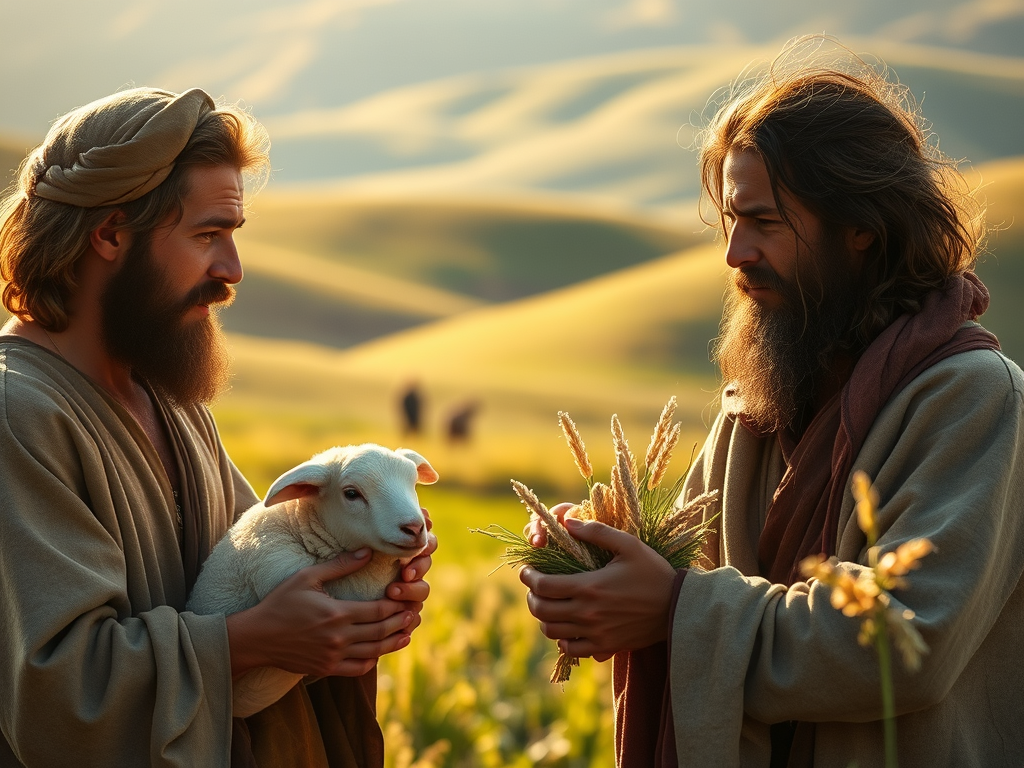
The Offerings
Now Abel was a keeper of sheep, and Cain a worker of the ground. 3 In the course of time Cain brought to the Lord an offering of the fruit of the ground, 4 and Abel also brought of the firstborn of his flock and of their fat portions. And the Lord had regard for Abel and his offering, 5 but for Cain and his offering he had no regard. So Cain was very angry, and his face fell.1
Above is the story from Genesis of Cain and Abel making offerings to God from the fruits of their labor, the first recorded example of worship in the Bible. We know from the text that God approved Abel’s offering, but did not approve of Cain’s offering, but there is nothing in the text that tells us what was wrong with Cain’s offering.
I find it interesting that Cain brought his offering first and yet it was rejected. A little more on that thought later.
So why was Cain’s offering rejected?
Why Did God Not Regard Cain’s Offering
There are many who speculate that God had regard for Abel’s offering because it was a blood sacrifice, while Cain’s was not favored because it was not a blood sacrifice. The language does seem to suggest Abel’s offering was a blood sacrifice, and the Bible does hint in Genesis that blood sacrifices were already atonement for sin because an animal had to die for God to clothe Adam and Eve. Noah offered a blood sacrifice upon leaving the ark, for example, so the idea of blood sacrifices was known even before they were commanded in the law of Moses.
It is interesting to note that this was called an “offering” and not a “sacrifice” leading me to believe the issue was not because a blood sacrifice was required. Both brothers brought gifts to God from the fruits of their labor. Cain was a farmer so it seems logical he would bring fruit as an offering to God, while it would be fitting for Abel to bring an animal offering because he was a shepherd. Still, the possibility of a required blood sacrifice should not be dismissed.
We have to look at the quality of the offerings, and what it represents. We see clearly in the ESV text above that Abel brought the “firstborn of his flock and their fat portions,” while Cain brought “fruit of the ground.” That is a hint that the offerings were not of equal quality.
It seems from this text that Abel’s offering was truly a personal sacrifice because he gave from the best of his flock, while Cain seems to have just gathered some fruit together and offered it to God, he wasn’t really sacrificing anything. Some have speculated that Cain just gathered up some fruit that had fallen on the ground, but I don’t think the text necessarily infers that.
The NLT translates it like this: “Cain presented some of his crops as a gift to the Lord. Abel also brought a gift—the best portions of the firstborn lambs from his flock.” While the CSB says, “Cain presented some of the land’s produce as an offering to the Lord. And Abel also presented an offering—some of the firstborn of his flock and their fat portions.”
The NLT and the CSB are very clear about this, Cain offered some of his crops and not the best of his crops, he kept the best crops for himself, while Abel offered the best he had to give.
Cain’s Heart Was The Problem
We know that God sees into the heart2 and we see from Cain’s reaction after God rejected his offering that his heart was not right. Instead of being sorrowful and ashamed for bringing a subpar offering to God, he became jealous, angry, and sullen and eventually exacted revenge on his brother for this perceived wrong.
God tried to give Cain a second chance when he asked Cain why he was angry:
“if you do well, will you not be accepted?” 3
God then warned Cain about sin crouching at the door. It seems that Cain was faltering even before this and God was trying to guide him along. God gave Cain a chance to repent, but we all know what happened next. Instead of repenting and admitting he was wrong, he multiplied his sin immeasurably.
Rather than being remorseful for his own shortcomings and actions, Cain acted as if he thought Abel purposely showed him up. Which brings me back to something I mentioned at the beginning of this post. Is it possible that Cain was trying to show up Abel by rushing to offer his sacrifice first, and in his haste offered a less than acceptable offering?
On top of all of this, we also learn from Hebrews 11:4 that Cain might not have had proper faith in God:
4 By faith Abel offered to God a more acceptable sacrifice than Cain,
This text shows us that Abel had faith in God which implies that Cain did not. Cain just made an offering to God he thought should be good enough.
In the end, even if God’s problem with Cain’s offering was that it was not blood sacrifice, the reason behind Cain’s subpar offering was the same. Cain’s heart was not in the right place and he did not have the proper faith in God. He just did what he decided would be good enough, rather than trying to please God.
What Does This Mean For Us
So what does any of this mean to us? How is this relevant to our lives today? We don’t offer sacrifices any more, but 2 Timothy 3:16-17 tells us that all scripture is useful for instruction so what can we learn from this?
For the answer we turn to Romans:
I appeal to you therefore, brothers, by the mercies of God, to present your bodies as a living sacrifice, holy and acceptable to God, which is your spiritual worship.4
We are to be living sacrifices to God, holy and acceptable. In order to do this we are to love and to serve God with all of our heart and with all of our soul. This will require from us what Cain was missing, a clean heart, which God will give us when we put our faith in him:
26 And I will give you a new heart, and a new spirit I will put within you. And I will remove the heart of stone from your flesh and give you a heart of flesh. 27 And I will put my Spirit within you, and cause you to walk in my statutes and be careful to obey my rules.5
We must use this new heart to honor and serve the God we love. This is our living sacrifice to the Lord and he will have regard for it.
If you enjoyed this content please scroll down and comment, subscribe, and share! You can also follow Cross Talk on Facebook by clicking on the link in the sidebar on the Cross Talk home page.

 Cross Talk
Leave a Reply