
Like all of us, David was a man who made mistakes. But despite all of his faults, and for all of his sins, God had mercy on him because his heart was fully and completely for God. Whenever David realized he sinned he turned to God with a contrite heart and begged for forgiveness.
When David was old and nearing the end of his life, he called Solomon in to see him. He needed to give Solomon some advice before the young man assumed the throne. David warned Solomon to walk in the ways of God, and to keep His statutes and His commandments so that he may prosper in all that he did (See 1 Kings 2:3-4).
Solomon loved the Lord, but…
Solomon Loved the Lord, But…
…he sacrificed on the high places (1 Kings 3:3).
Although the permanent temple had not yet been built, God had commanded the Israelites to burn down the altars on the high places where other gods had been worshiped. There was to be one spot used to sacrifice to the Lord, which He would show them (Deuteronomy 12:2-7). At the time of Solomon this place was to be at Gibeon.
Yet, instead of destroying the high places, Solomon was offering sacrifices on them. Even though he was worshiping the one true God, he was worshiping Him improperly. At the beginning of his reign Solomon loved God, but it was not complete love.
Unlike the love his father had for God, there was still part of him that wasn’t fully and completely dedicated to Him. Over time this “but” went from being the exception to being the rule. Solomon began to slide further away from God.
Solomon’s Slide
Solomon’s slide began simply enough. Just a small compromise; he violated Mosaic law (Deuteronomy 17:17) when he made a political alliance with his marriage to Pharaoh’s daughter.
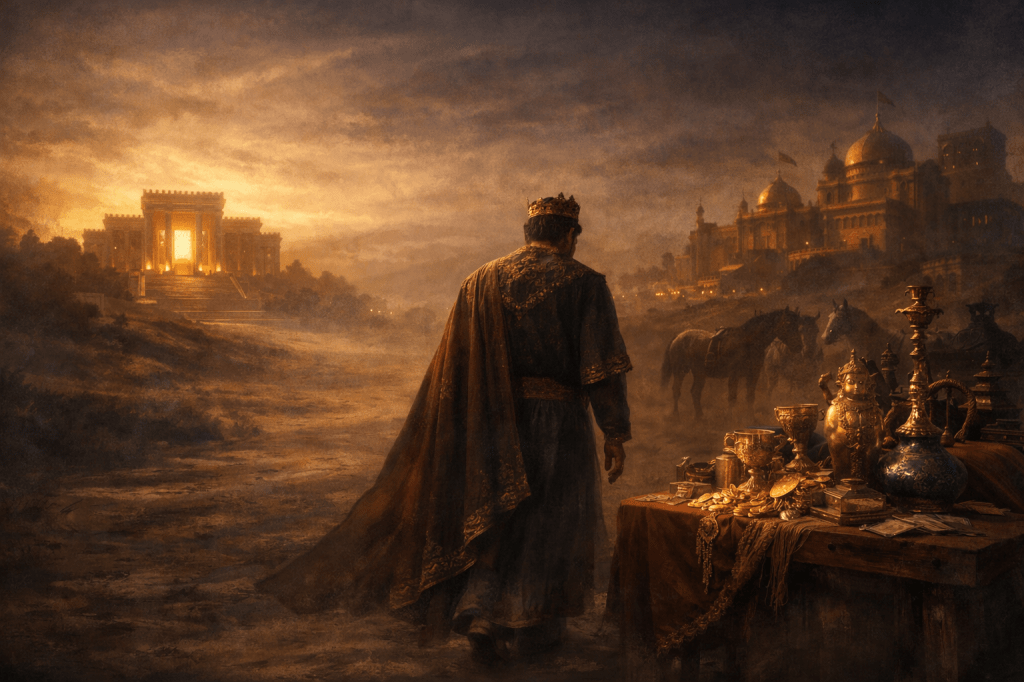
That was just the beginning: he accumulated horses and chariots from Egypt, in violation of Mosaic law (Deuteronomy 17:16). It’s true that he built a glorious temple for the Lord, but…
He also spent twice as much time building a house for himself that was twice as large as the temple. His priorities were shifting to worldly concerns.
His slow slide away from God culminated when Solomon disregarded Mosaic law altogether by marrying hundreds of pagan wives. To appease his wives, he built temples to their gods so they could worship. Eventually he began to worship those gods himself.
All of this shows us a slow decline in Solomon’s faith, as he drifted away from the Lord while focusing on his earthly possessions and power. At the beginning of his reign Solomon asked God for wisdom, but at the end of his reign he had lost his discernment.
The Israelites were under such a heavy yoke at the end of his reign that they asked Rehoboam to lighten the yoke after Solomon’s death. Rehoboam refused, and decided to make their yoke heavier. This eventually led to the downfall of the kingdom (1 Kings 12:4-11). Solomon’s slide had consequences beyond himself.
Can this happen to us?
As Solomon’s example demonstrates, the biggest threat to faith is a slow deterioration over time, one small compromise after another. You might wake up one day and suddenly realize your faith is gone, but it usually comes after a slow and steady decline. This happens when God goes from being your motivation to an afterthought.
What do we have in our lives that draws our attention away from God? Solomon loved the Lord, but. Perhaps with us it isn’t “but” but “and.” We love God, and…
…our careers, our position, getting attention, our hobbies, our goals, and the list goes on.
When we have something that attracts our attention to the point where it diverts us from God, we have an idol that will slowly pull us away from God if we are not careful. God needs to be the center of our lives, not just on the periphery.
Is Christianity just a title we claim for ourselves, or is it our lifestyle?
The most dangerous part of all of this is the gradual deterioration of faith. For just that reason–it’s gradual. It happens in increments so small that it’s almost undetectable if you aren’t paying attention. A compromise here and a compromise there. Faith goes from being at the forefront of our thoughts to the back burner. Eventually it dwindles out and dies if we do not keep the flame burning brightly.
While discussing freedom in America James Madison said, “I believe there are more instances of the abridgment of the freedom of the people by gradual and silent encroachments of those in power than by violent and sudden usurpations.”
He was talking about making small compromises over time. While James Madison was talking about the slow erosion of freedom, it is the same principle when it comes to faith.
If you don’t guard your freedom and you make compromises, it will slowly disappear. If you don’t guard your heart and mind in Christ Jesus (Philippians 4:7), your faith will slowly slip away. The freedom you once had in Christ will give in to the gradual and silent encroachments of sin.
If we are not careful, we will be “tossed to and fro by the waves and carried about by every wind of doctrine, by human cunning, by craftiness in deceitful schemes” (Ephesians 4:14 ESV). We need to hold to the word of life so we don’t run the race in vain (See Philippians 2:16).
The backlash of the waves against the shoreline causes the long-term structural erosion of the beaches. Our faith can be the same. If we are not diligently following Christ our faith will dwindle away, one grain of sand at a time.
If you enjoyed this content please scroll down and comment, subscribe, and share! You can also follow Cross Talk on Facebook by clicking on the link in the sidebar on the Cross Talk home page.

 Cross Talk
Leave a Reply