
Wandering in the Desert
God chose Moses to lead His people out of slavery from Egypt, and into a land flowing with milk and honey. But when the people were standing on the threshold of the Promised Land they grew faint of heart. They didn’t trust God to deliver them into the land despite His promise.
So God punished them; the people were not allowed to enter the Promised Land. Instead they were to wander in the desert for forty years, until all of the adults who balked at entering the land were dead.
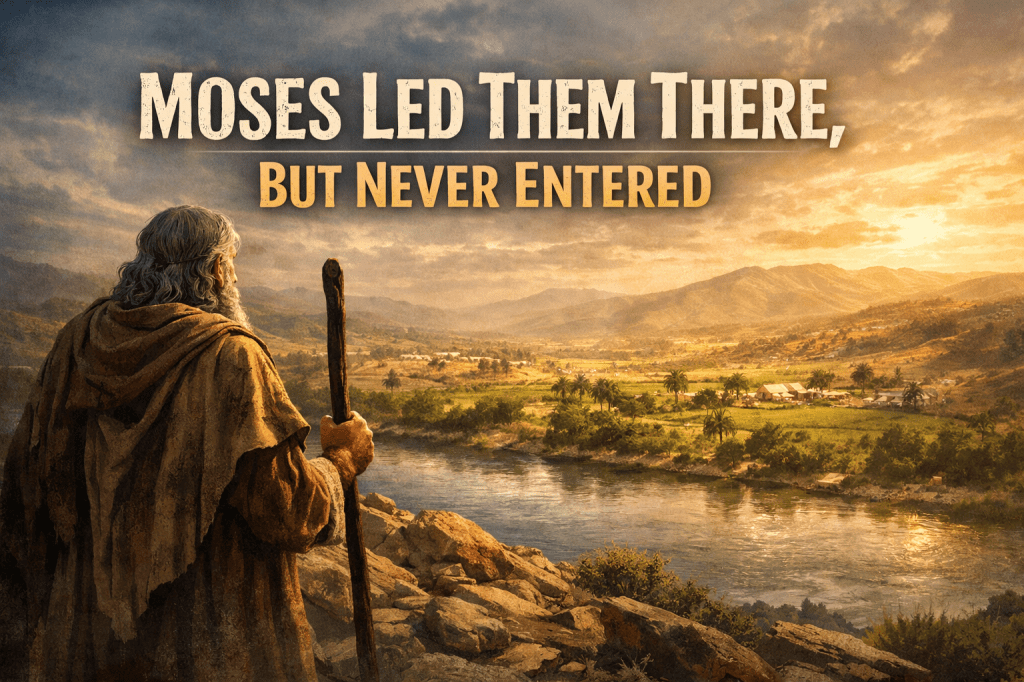
Moses was standing on the edge of the Promised Land for the first time, but because of the people’s sin he would not enter it. Forty years later he would lead the people to the edge of the Promised Land again, but this time he would not be allowed to enter for a different reason…
During the desert wandering period Moses led the people according to God’s will. When God wanted them to move, they moved. When He wanted them to stay, they stayed. Moses also taught the people God’s law and judged them according to it.
But they were a stiff-necked people (Exodus 32:9), and Moses had to intervene for them several times. On these occasions, God became angry and wanted to destroy them for their insolence. No matter how much God provided for them they always wanted more. Time and again Moses interceded when the people grumbled against God.
Moses Sins Against God
But then one day Moses disobeyed God.
When the people complained of being thirsty at Meribah, God commanded Moses to speak to the rock and it would bring forth water for His people. Instead Moses struck the rock twice saying, “shall we bring water for you out of this rock?” (Numbers 20:8-11).
Because Moses didn’t obey God’s instructions he was punished. He would not be allowed to enter the Promised Land. Joshua would be the one to lead the people into the Promised Land when the forty years were over.
A Harsh Penalty
Why such a harsh penalty for what seems like a small sin committed by a loyal servant? Isn’t it possible Moses just made a mistake? After all, at Horeb God did command Moses to strike a rock to get water from it (Exodus 17:6). He was getting older, maybe he just got confused…
When we ask these types of questions we are trying to rationalize or justify sin.
This seems like a harsh punishment to us because we are judging God by our flawed standards, but God judged Moses by His perfect standard. There is a vast difference between God’s justice and man’s sense of right and wrong.
Why was God’s penalty so severe? That’s actually a fair question and many people have asked it over the years. Myself included. There is more to this than we see at first glance. We need to understand that all sin is rebellion against God, so all sin is serious. There is no such thing as an insignificant sin. James tells us that when we fail in one point of the law we are guilty of breaking it all (James 2:10).
This, by itself, is usually an unsatisfying answer for people. But Moses was also the people’s leader. Leaders and teachers are expected to set an example for their followers, so they are judged more harshly (James 3:1).
Besides this, there are three additional reasons why God saw this sin as being so egregious:
First, Moses let his emotions get the better of him and he struck the rock in anger. Second, he disobeyed a direct command from God. Third, and most importantly, he didn’t give the glory to God for providing the water, but instead took credit for the miracle when he said, “shall we bring water for you out of this rock?”
In addition to this, Moses never actually takes full responsibility for his sin at Meribah. Instead, in Deuteronomy he blames the people for his actions (Deuteronomy 3:26). While this wasn’t a reason for God’s punishment, the refusal to accept his own culpability in this instance reveals a character flaw in Moses.
While God chose Moses to be His leader, it wasn’t because he was a perfect person. Moses had flaws just like all men do, and Meribah was one example of his flaws. Let’s look at some of those flaws.
Moses’ Flaws
Moses had an anger issue, and he was also reluctant to lead when God called him: As a younger man he fled into the desert after killing a man in anger (Exodus 2:11-15), and at the burning bush he begged God to choose somebody else to lead the Hebrews (Exodus 3:11-4:13).
But there’s more. At one point God sought to kill Moses for not obeying the circumcision laws and his wife Zipporah had to come to his rescue (Exodus 4:24-26). So on first blush it might seem as if God was harsh on Moses for this one incident, but Moses had a history, and although he was a great leader he was not perfect. He had to be held accountable for his sins, just like the people he led were.
But…
Redemption in the End
…when Moses was 120 years old he climbed Mount Nebo. Even at this advanced age he had not lost his vigor and his legs were still strong (Deuteronomy 34:7). He climbed the mountain with no assistance but the staff of God which he had leaned on his entire adult life. His eyesight had never dimmed, and his clothes and sandals had never once worn out (Deuteronomy 29:5). Despite wandering the desert for forty years his feet never swelled (Deuteronomy 8:4).
When he reached the peak at Pisgah he saw the Promised Land that God had promised his people. For the second time in his life he stood on the edge, but would not be allowed to enter. The first time because of the people’s sin, and now because of his own.
I can picture it: As he lay down, he looked at the land flowing with milk and honey, longing to enter it. He breathed his last while looking at that glorious sight, and he passed from the mountain into the Heavenly Promised Land. This was a land not flowing with milk and honey, but with living water (Revelation 22:1).
We look at that one incident and we think God treated Moses harshly, but when you look at the whole of Moses’ life you realize that God sustained him and treated him mercifully right up until the moment he passed into eternity.
If you enjoyed this content please scroll down and comment, subscribe, and share! You can also follow Cross Talk on Facebook by clicking on the link in the sidebar on the Cross Talk home page.

 Cross Talk
Leave a Reply