
The Flying Spaghetti Monster
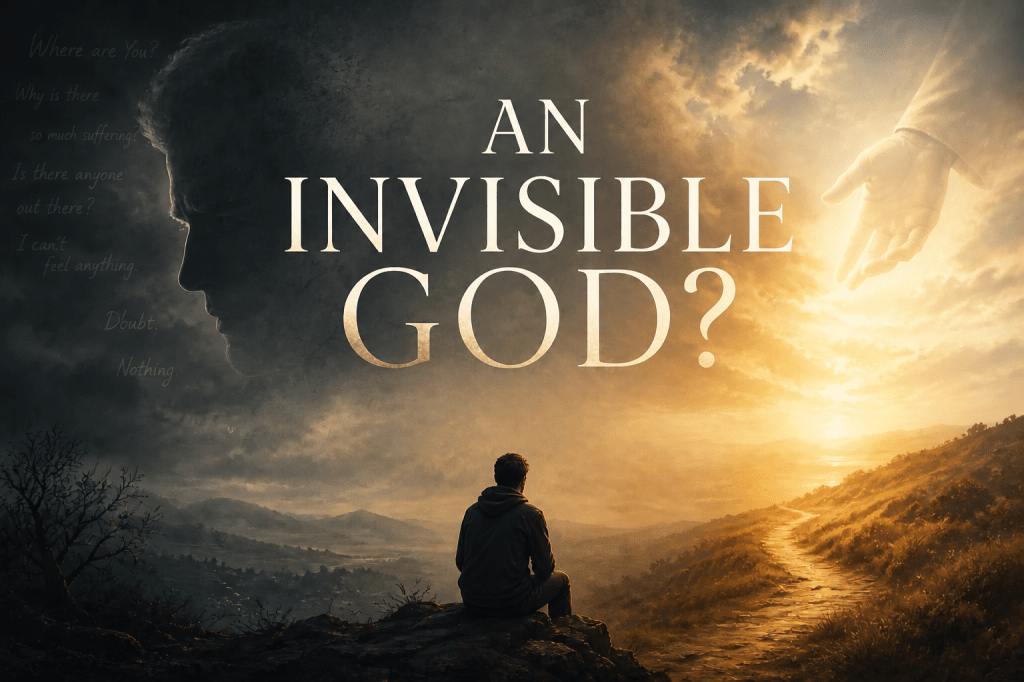
How can you believe in an invisible God? How can you believe in this giant unseen magician who is hiding from us while pulling the strings to make us dance to His tune? If God is real why doesn’t He just reveal Himself?
We’ve all heard skeptics ask questions like this before. Some of them are asking fair questions in an attempt to understand. However, others are antagonistic and only ask questions in derision. Some people aren’t content simply questioning God’s existence. They mock Christians for their beliefs. One example of this is Bobby Henderson.
He was so disturbed at the possibility of Intelligent Design being taught in schools that he created his own religion around a supreme being called the flying spaghetti monster.1 His theory was that if Intelligent Design were taught in schools then his “religion” should be as well.
But ridicule isn’t argument, it’s deflection. It doesn’t take reason to ridicule someone or something. Bobby Henderson wasn’t directly arguing why Intelligent Design shouldn’t be taught, but using the issue to taunt those who believed in an invisible God.
Intelligent Design doesn’t necessarily point to the Christian God, even Bobby Henderson’s flying spaghetti monster would theoretically fall under the umbrella of Intelligent Design. If Intelligent Design were taught in schools, the door would still have been open for his created god. His argument therefore was nonsensical. It wasn’t supposed to make sense, and that was his point.
We are going to answer the question, “How can you believe in an invisible God?” But we will be using reason instead of ridicule. We are going to look at how even skeptics already believe in invisible concepts, so the leap to the concept of an invisible God is not as great as they might think.
For centuries philosophers have debated the concepts of abstractions, constants, the mind, and how these things relate to the beginning of our existence. I’m not going to be treading new philosophical ground, but today we are going to examine some of these age-old concepts together.
The Mind and Other Abstract Concepts
It’s true that we live in a tangible world, and it’s true that we like to be able to see things for ourselves. However, it’s also true that not everything in this world is tangible.
We can’t see love, mercy, justice, wisdom, and goodness themselves, but we know they exist. These are just a few of the abstract concepts that people know are true.
We become aware of these abstractions through the mind. The mind itself, unlike the brain, is an abstract concept. We don’t question the existence of mind; instead we use our abstract minds to question other abstracts. Cogito ergo sum.
These abstract, intangible concepts are made known to us through the abstract mind but are separate from it. They do not originate in the mind. There is also another category of intangible truths that subsist outside the mind. These are known as constants. Mathematical truths are constants, along with the other formal sciences, such as statistics and logic. We didn’t invent these, we discovered them.
One plus one will always equal two. A German person will say eins plus eins ist gleich zwei, and a Spanish person uno más uno es igual a dos, but the underlying truth is the same no matter what words we use to express it. These constants existed before we discovered them. Even the universe is governed by an invisible cosmological constant.
Where do Invisible Truths Subsist?
These constants are always true, and they would still exist even if our minds didn’t. Where did these constants come from and where do they subsist?
They have to subsist somewhere. If constants govern the universe, they must be independent of it.
Even if evolution is true, and all physical matter came into being through an unguided natural process, it would still not account for the constants. By definition constants are the unchangeable laws of nature and science, and do not evolve. The way we understand them might evolve, but they remain the same.
We’ve already determined that these things exist independently of our minds, and now we’ve eliminated the universe as their habitation, so there must be another answer to the question.
These truths are not confined to a physical location, time, or space; they are eternal and must dwell in a mind of some type. Even if we weren’t here they would still be true. So that mind has to be greater than our minds and greater than the universe. It also must be outside of time and space, and it must be eternal.
The next logical step is that there is an invisible creative mind behind our minds, all the abstractions that become known through them, and the constants that live outside of them. This superior mind is God. God is the ultimate constant, the one from whom all the others come. The One who was, who is, and who always will be.
A Leap or Just a Step?
Skeptics already believe in these invisible realities, it isn’t that far of a leap to believe in the ultimate invisible reality. Søren Kierkegaard’s leap of faith isn’t as great as one might think. In fact, it’s just a simple step.
We talked about the abstract concepts of love, mercy, justice, wisdom, and goodness above. The Bible calls these the transferable attributes of God. And while they are invisible, we can see what they look like through the actions of people. When Scripture says God made us in His image, this is what it means. We can see God working through the actions of His people.
Ironically, it is the mind that shuts out the possibility of God for many people. They use their thoughts to think away God, closing their mind to other possibilities. If you are predisposed to disbelieving, you have prematurely drawn your conclusion because you have eliminated the alternatives. But if you open your mind to the possibility of a higher power, you open yourself up to the possibility that while you can’t touch God, He will reach down and touch you.
If you enjoyed this content please scroll down and comment, subscribe, and share! You can also follow Cross Talk on Facebook by clicking on the link in the sidebar on the Cross Talk home page.
- The Church of the Flying Spaghetti Monster was created by Bobby Henderson to oppose teaching intelligent design in U.S. public schools. Adherents, known as Pastafarians, argue it is a legitimate religion, promoting a light-hearted, non-dogmatic worldview that champions the separation of church and state. ↩︎


Leave a Reply