
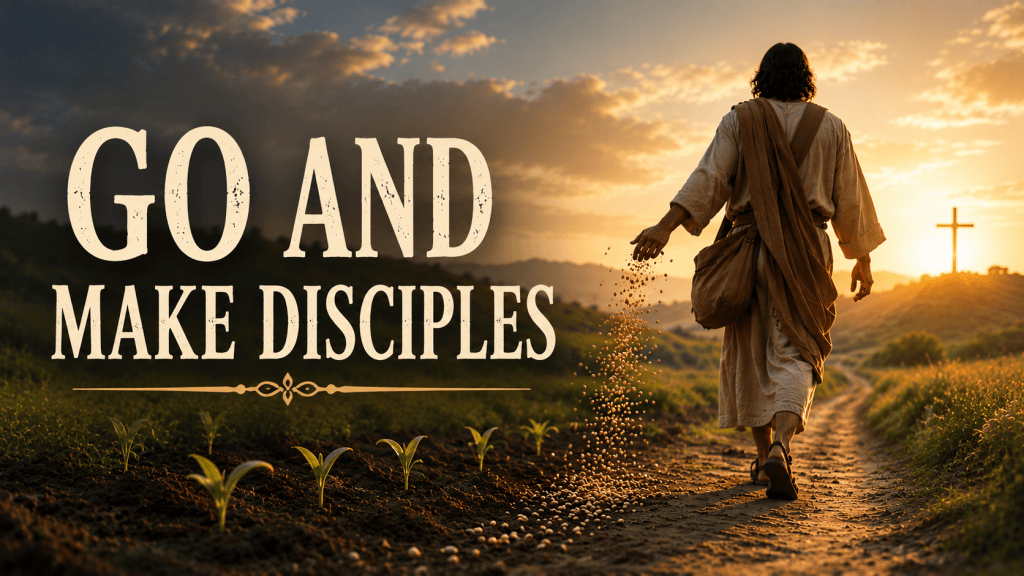
The Great Commission is Our Commission
Before Jesus ascended into heaven, He told His followers to go and make disciples of all nations (Matthew 28:19-20). We believe this commission didn’t end with the original disciples. As Christians, we are all disciples and we have also been tasked to spread the good news of Jesus Christ. The Great Commission is our commission.
Sometimes We Hesitate
Jesus commanded us all to go and make disciples. We know what we are supposed to do, yet sometimes we hesitate…
It’s a simple command, but it’s something that many of us struggle with. We have all sorts of excuses: Will I know what to say? What if I mess up? What if I fail? I don’t know enough theology. I don’t have all the answers.
All of these are understandable concerns, and many of us feel the same way at times. Even Moses had some of these same concerns when he was first called by God at the burning bush. Moses asked God: Who am I? Who are you? What if they don’t believe me? He also reminded God that he wasn’t a good speaker. You can read more about Moses’s reluctance here.
The important thing is that Moses eventually did what God wanted him to do. Even though he was hesitant and uncomfortable, he became obedient. God was with him and he became a great leader. We must also put aside our discomfort and be obedient. God will be with us too.
Moses was called a servant of the Lord, and we’re also servants of the Lord. Our service will differ from person to person, and none of us will serve God the way Moses served Him. But there is one thing our service should include: spreading the good news about Jesus Christ.
We might not think we are good enough to be messengers, but we have some great role models that show us that we don’t need a perfect past to be used by God to spread His word.
Our Role Models
Peter is a great example. He denied knowing Jesus three times when Jesus was arrested and put on trial. He was hiding after the crucifixion because he was afraid. After Jesus’ resurrection, he changed. He became a bold leader in the early church. What changed? It wasn’t his circumstances. Peter was filled with the Holy Spirit. His initial failure to admit he knew Jesus didn’t disqualify him.
Many of the apostles were uneducated men, not studied theologians. Along with Peter, they were also hiding in a locked room after Jesus’ crucifixion because they were afraid of being persecuted for knowing Jesus. Yet once the Spirit came upon them, they stepped out of the shadows and became bold in proclaiming His name. Their circumstances hadn’t changed; the Spirit changed them.
On the other hand, Paul was a studied theologian. Paul had the knowledge of Scripture from the greatest teachers of the time, and yet Paul failed to recognize that Jesus was the Messiah. Paul was persecuting Christians because he misunderstood God’s will. Then he met Jesus on the road to Damascus, and his life was changed. He went on to boldly proclaim the name of Jesus, and he planted churches all throughout the region. His failure to recognize Christ, and his persecution of those who did, didn’t disqualify him.
We are also given the Spirit when we accept Jesus. The key is to learn to rely on the Spirit, and not on our own understanding. We need to let the Spirit change us.
Confusing the (Com)Mission
How many times have you had an opportunity to witness to somebody and you didn’t have the words? How many times did you get home before realizing what you should have said after replaying the conversation in your mind? I’m sure this has happened to us all.
I know it’s happened to me more than once. Sometimes with me it’s because I didn’t listen properly. I was listening so that I could come up with a response. Instead, I should have truly listened to what the person was saying and then let the Spirit guide me. Only when I got home did I discern the Spirit.
Sometimes we confuse the mission. We are not called to make instant converts. That rarely happens. Because Jesus told us to go and make disciples of all the nations, we can sometimes think we need to make them instantly.
But not making an instant disciple doesn’t mean we failed at the Great Commission. We aren’t always going to have all the answers. If we did, we’d be God. If people don’t listen to our words we need to shake the dust off our feet and move on (Matthew 10:14). It doesn’t mean we should give up on the message, or on the person. Maybe we’ll have another opportunity with this person, but maybe the next opportunity will be with somebody else. Either way, we are to continue spreading the word.
There is only one who proclaimed the word perfectly, and that was the Word Himself. We will never be perfect like Jesus was, but we should strive to follow His example. Even Jesus had people walk away from Him because they didn’t accept His teaching (John 6:66).
We might feel like we failed, but did we fail in God’s eyes? We did what God commanded. We were obedient to His call. Some of us plant the seeds, some of us come along and water the seeds, but the growth belongs to God.
Paul wrote about this: “I planted, Apollos watered, but God gave the growth. So neither he who plants nor he who waters is anything, but only God who gives the growth” (1 Corinthians 3:6-7). We sometimes confuse our roles with God’s role.
Are you afraid of rejection? Many times I am as well, but we need to make sure people hear about Jesus so they’ll have an opportunity to believe. How can they believe if they haven’t heard? And how can they hear if they aren’t told? (Romans 10:14).
When we hesitate to spread the gospel we are being disobedient. Would you rather be successfully disobedient, or would you rather appear to fail while being obedient?
If you enjoyed this content please scroll down and comment, subscribe, and share! You can also follow Cross Talk on Facebook by clicking on the link in the sidebar on the Cross Talk home page.


Leave a Reply