
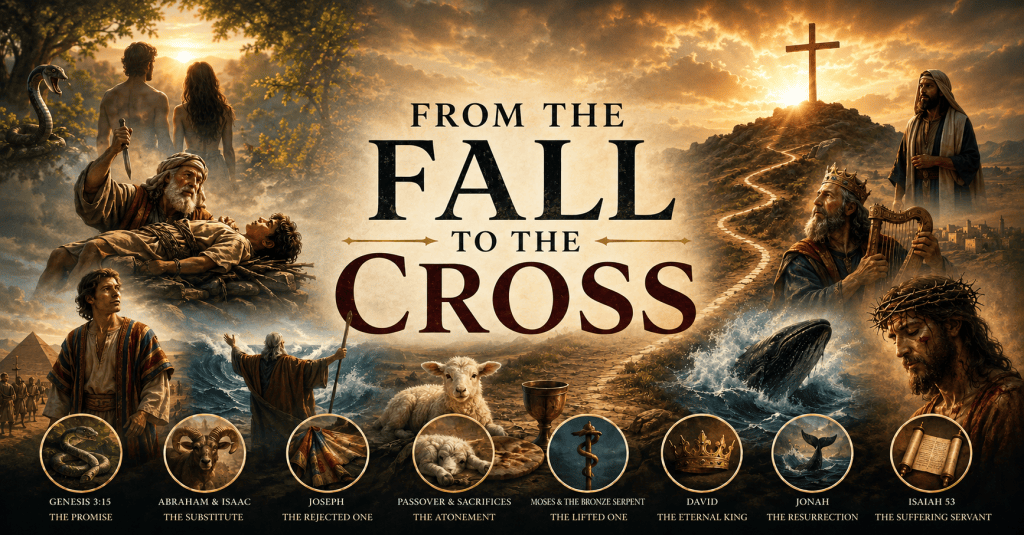
Typology
Typology is the study of people and events in the Old Testament that foreshadow or point to Jesus Christ. These are not accidental similarities or coincidences. They show that God’s plan for redemption was revealed all the way back in Genesis and permeates all of Scripture.
The entirety of the Old Testament points to the coming of Jesus Christ. It begins with the promise in Genesis that the seed of the woman would bruise the head of the serpent, continues to Moses, through the line of David in the books of Kings and Chronicles, and all the way into the New Testament, to Jesus’ resurrection. There is a typological thread that runs through the entirety of Scripture.
God’s plan goes back even before the Fall; once Adam and Eve fell it wasn’t as if God had to come up with another plan. He didn’t panic and ask Himself, “Now what do I do?”
From the Fall…
Today we are going to take a journey through the Old Testament to look at some examples that show us how much of it foreshadows or prefigures the coming of the Messiah. We’ll start in Genesis 3. This is where the first prophecy of the Messiah comes to us. This is where the redemptive story starts in Scripture.
After the Fall, God handed down punishment. First He punished the serpent, and this is where the first Messianic prophecy is revealed: “I will put enmity between you and the woman, and between your offspring and her offspring; he shall bruise your head, and you shall bruise his heel” (Genesis 3:15 ESV).
The serpent will strike the seed and bruise His heel, but when victory looks to be at hand the serpent’s head will be crushed. He will be defeated by the Messiah.
We will continue on this journey through Genesis, picking up with Noah, and then the story of Abraham’s willingness to sacrifice his son Isaac.
…Through Genesis…
Mankind became increasingly wicked after the fall. It started when Cain killed Abel and culminated in the great flood, when God purged the earth through water. Noah was a preacher of righteousness (2 Peter 2:5) in a wicked world who saved his family from God’s judgment, foreshadowing the later salvation through Jesus. Peter draws a typological connection between the flood and baptism (1 Peter 3:20-21).
It didn’t get better after the flood. Mankind repopulated the world and continued to sin.
When mankind tried to build a tower to heaven at Babel, God dispersed the people throughout the world and confused the languages.
From here we pick up the thread again with the story of Abraham and Isaac. God called Abram out of Ur and promised to make him a great nation, even though he was old and his wife was barren.
God changed Abram’s name to Abraham and granted him a son in his old age. God then called on Abraham to sacrifice his much-loved son, only to spare him at the last minute by providing a substitutionary sacrifice in his place.
Some of the foreshadowing of Jesus’ sacrifice on the cross is obvious, such as Abraham’s willingness to sacrifice his son, Isaac carrying the wood for his execution, and Isaac being willing to obey his father, even unto death. But there is more to the typology in this story. There’s too much to list in this article, please check out more here.
God’s promise to Abraham was eventually fulfilled through Jacob. Now we continue to follow the thread through Jacob’s son Joseph.
Joseph also has a large typological connection to Jesus: He was rejected by his own people and sold into slavery. During his time in Egypt he gained favor with Pharaoh, but was unjustly imprisoned when false accusations were made against him. Joseph was in prison with two other men, one of whom was saved by the king and one who was not. This reminds us of the two thieves on the cross.
He was eventually freed from prison and ended up being a savior to his family and to the Egyptians during the famine.
Joseph passed away and eventually the Hebrew people were enslaved by Egypt. This is where Genesis ends and Exodus begins.
…Through Exodus, Leviticus, and Numbers…
Moses was chosen by God to deliver His people out of bondage. Once they were free, laws were set up which included the celebration of the Passover and the sacrificial system of atonement. Both the Passover celebration and the sacrificial system foreshadow the coming final sacrifice of the Messiah.
During the desert wandering period Moses served as an intercessor between God and sinful man. This intercessory system was kept in place through the Levitical priesthood until ultimately Jesus became our intercessor.
At one point God sent fiery serpents to punish the Israelites. Moses crafted a bronze serpent and lifted it up on a pole. Whoever was bitten but turned to stare at the bronze serpent was saved. Centuries later Christ would be lifted up on a cross for all of those who call on His name to be saved. Jesus made the connection between Himself and the bronze serpent in John 3:14-15.
Long before the Levitical priesthood was set up, there was another mysterious priest who met Abram on the road after a victory in battle. His name was Melchizedek and he was not only a priest but he was also a king. Many years later the author of Hebrews would use the example of Melchizedek to show there was precedent for Jesus being a non-Levitical priest and a king.
Now the thread takes us into kings and the prophets.
…Through the Kings and to the Prophets…
The Israelites demanded a king when they decided they wanted to be just like every other nation around them. Samuel was reluctant, but God told him to give the people what they wanted. Saul became the first king of Israel.
After Saul lost favor with God, David was anointed by Samuel to be the next king. However, it wasn’t until Saul was killed on the battlefield that David was officially recognized as king over Israel. David, like Christ, was a shepherd king. He was also originally rejected as king and lived as an outcast hiding from authorities.
King David was a man after God’s heart and God promised him that he would have a son on the throne of Israel forever.
Although he eventually strayed, David’s son Solomon is also a type of Christ: He was a wise man, and a man of peace, whom people came to listen to from all over the world. And he completed the work of his father by building the temple.
Even when the kingdom was split in two after the death of Solomon, God remained faithful to His promise. There was always an heir to the throne in the southern kingdom. Once Judah was carried into exile there was technically no king, however the line of David was never extinguished. It traveled through Jehoiachin through to Zerubbabel and eventually to Jesus Christ–the eternal heir.
This thread now takes us to the prophets. First we come to Elijah and his protégé, Elisha. Elijah brought a widow’s son back to life and was taken up into heaven bodily. Elisha performed several miracles that foreshadow the miracles Jesus later performed. He multiplied food, healed lepers, and also brought the dead back to life.
Now we arrive at Jonah, who lived during the reign of King Jeroboam II in the northern kingdom. Like Solomon, Jonah is another man who had flaws but was still a foreshadowing of Christ. Jesus Himself referred to Jonah as a sign, because he spent three days inside the belly of a great fish before being returned miraculously.
And lastly, we come to Isaiah. Although he is not a type, he is included here because over 700 years before the birth of Christ he gave one of the clearest prophecies of the Messiah as a suffering servant who would be “pierced for our transgressions” (Isaiah 53:5), showing us that this was God’s plan from the beginning.
We started in Genesis with a prophecy of the coming Messiah, and we end our Old Testament study also with a prophecy.
…To the Cross
What we have seen throughout this journey in the Old Testament is remarkable. We started in Genesis with the first prophecy of a redemptive savior, then continued through Genesis with Noah. From here we saw Abraham not withholding his son as a sacrifice, and Joseph being rejected by his own.
We moved into Exodus with Moses as intercessor, the Passover and sacrificial system, and the Bronze serpent pointing the way to Christ. We touched on Melchizedek. From there we looked at the everlasting line of David through Kings, and the prophets who predicted what comes next. We have now arrived at the cross.
And we’ve discovered how all of these things foreshadow the coming sacrifice of Jesus Christ. What is truly remarkable about this is that this thread covers thousands of years and roughly thirty to forty different authors. This was not a concerted effort by men to create a narrative woven through time. Rather, time was woven through God’s narrative.
If you enjoyed this content please scroll down and comment, subscribe, and share! You can also follow Cross Talk on Facebook by clicking on the link in the sidebar on the Cross Talk home page.


Leave a Reply